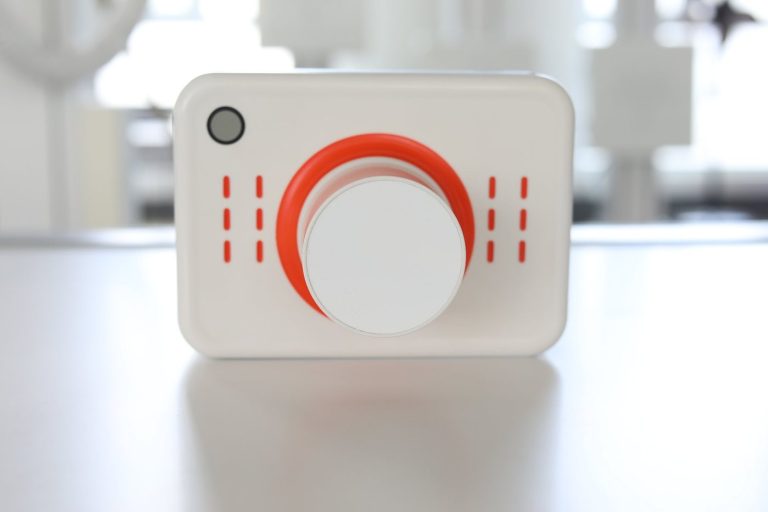
“handheld X-ray machine” is not one product category — it is a name shared by three very different devices: a battery-powered intraoral dental unit, a handheld fluoroscope that shows live images on a small screen, and a portable radiographic generator that is light enough to carry but far too powerful to hold during an exposure. Buying the wrong one is expensive, and the confusion is understandable, because all three are marketed with the same phrase.
This page is the plain-language map of the territory. It explains what each of the three devices actually is, who each one is for, what the numbers on a spec sheet mean in each category, and how to tell which one your use case requires — before you request a quote.
Why One Name Covers Three Machines
The confusion exists because all three devices solve the same underlying problem: radiography equipment was designed for a fixed room, and a large share of real-world imaging does not happen in one. Dental operators move between chairs and operatories. Surgeons need live imaging at the table without wheeling in a full C-arm. Field clinics, ambulances, stables, and home-visit services cannot install a radiology suite at all.
Engineering answered with three different levels of “portable,” and marketing compressed all three into one phrase. The devices differ in what they image, how they are held, how much output they produce, and who is allowed to operate them. Treat the three sections below as three separate shopping trips.
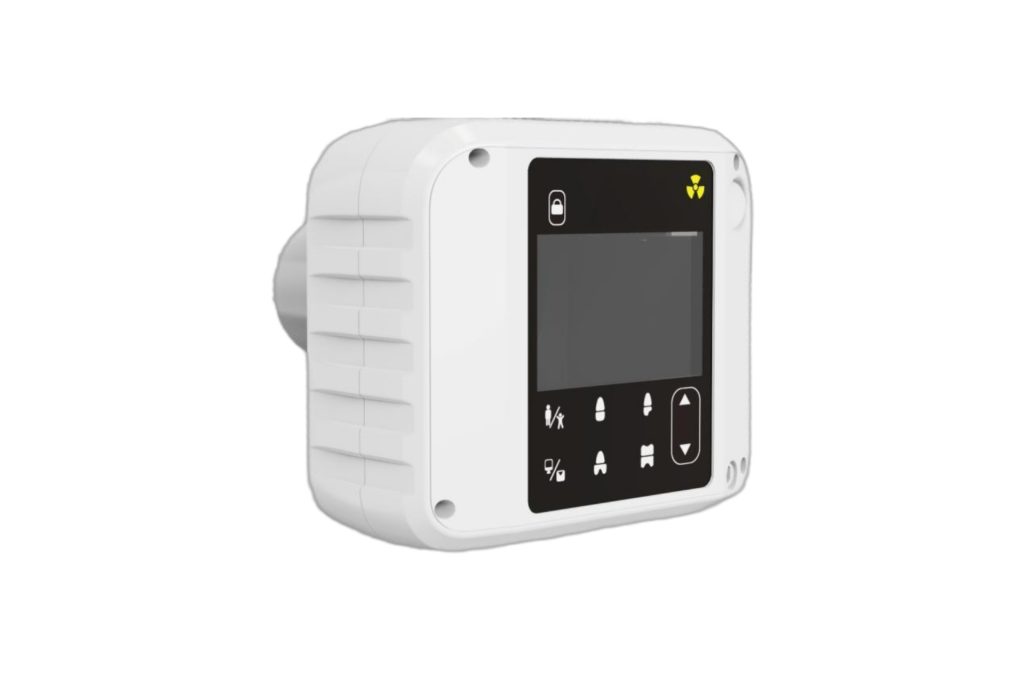
Type 1: The Handheld Dental X-Ray Unit
This is the device most people picture first: a pistol-grip intraoral X-ray source with a rechargeable battery, a beam-limiting cone, and an integrated backscatter shield. The operator stands beside the chair, positions the cone against the patient’s cheek, and triggers a short exposure — typically in the 60–70 kVp range across the category.
Its defining trait is that the operator holds the radiation source during the exposure, which is why compliant units carry features you should never see removed: a backscatter shield at the cone edge, a secured trigger that prevents accidental firing, and clear audible and visual indicators while radiation is being produced.
Who it is for: dental practices that want a second source without a second wall arm, mobile dental services, and clinics where several operatories share one unit. You can browse the current handheld dental X-ray unit range to see how these configurations differ.
What it images: periapicals and bitewings onto an intraoral sensor or film. It does not image the chest, the abdomen, or anything beyond the oral cavity — a common misunderstanding among first-time buyers.
The receptor side of this purchase matters as much as the source: sensor type, active area, and compatibility decide image quality and retake rates. We cover that in depth in our handheld dental X-ray machine buyer’s guide, which pairs this device with the sensors it exposes.
Type 2: The Handheld (Portable) Fluoroscopy Machine
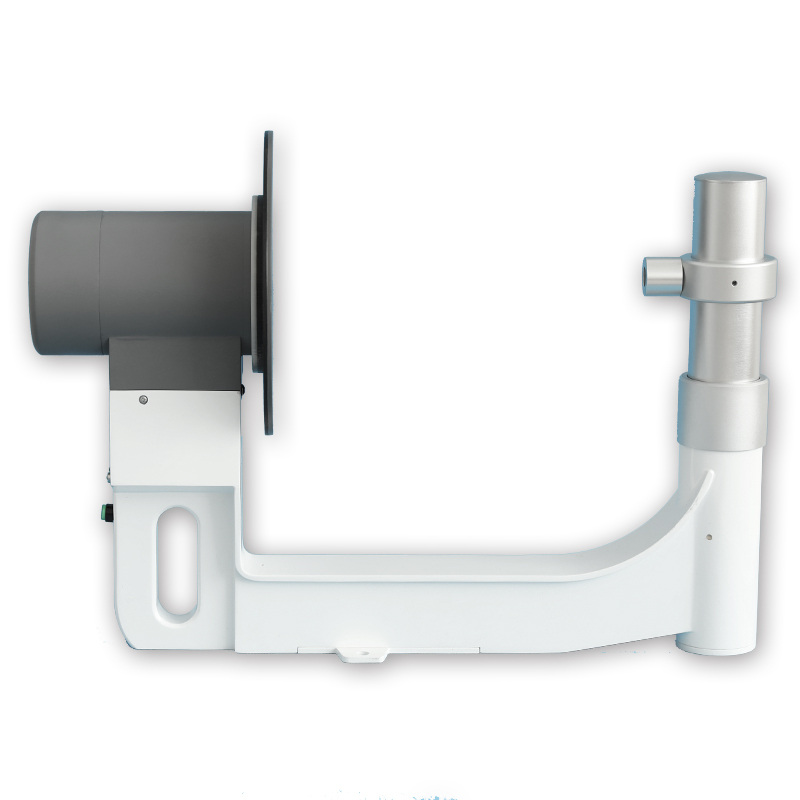
The second device looks similar at a glance — a compact head, a handle, a small form factor — but does something fundamentally different: it produces a continuous live image instead of a single exposure. Small C-arm-style fluoroscopes in this class put the image intensifier and detector into one handheld head and display the moving image on an attached screen or an external monitor.
Who it is for: orthopedic fracture reduction and hardware positioning, foreign-body localization, and veterinary procedures — settings where a surgeon or veterinarian needs to see movement in real time but a full C-arm cart is impractical. The portable fluoroscopy systems in this class differ mainly in screen and field size, which is why those two numbers deserve the most attention.
What the spec sheet says: tube potentials commonly run in the 45–90 kV range across the category, total weight stays anywhere from roughly 4 kg for the smallest units to about 9 kg for large-screen versions, and the viewing field is the number that actually drives the choice — from small circular fields around 50 mm in diameter up to rectangular fields in the region of 220 × 160 mm on integrated large-screen models. A bigger field sees more anatomy at once; a smaller field keeps the head light and the scatter manageable.
The key distinction: because a fluoroscope runs continuously, dose management is a workflow skill, not just a hardware feature. Pulse settings, collimation, and keeping the beam-on time short matter more here than in any single-exposure device.
Type 3: The Portable Radiographic Unit (Which You Do Not Hold)
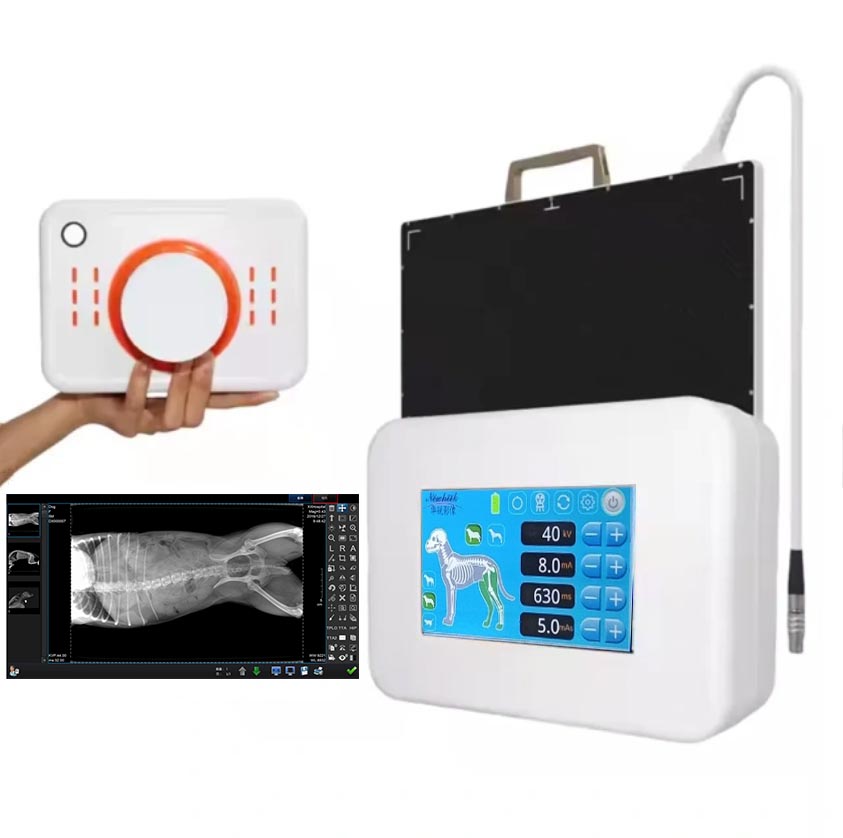
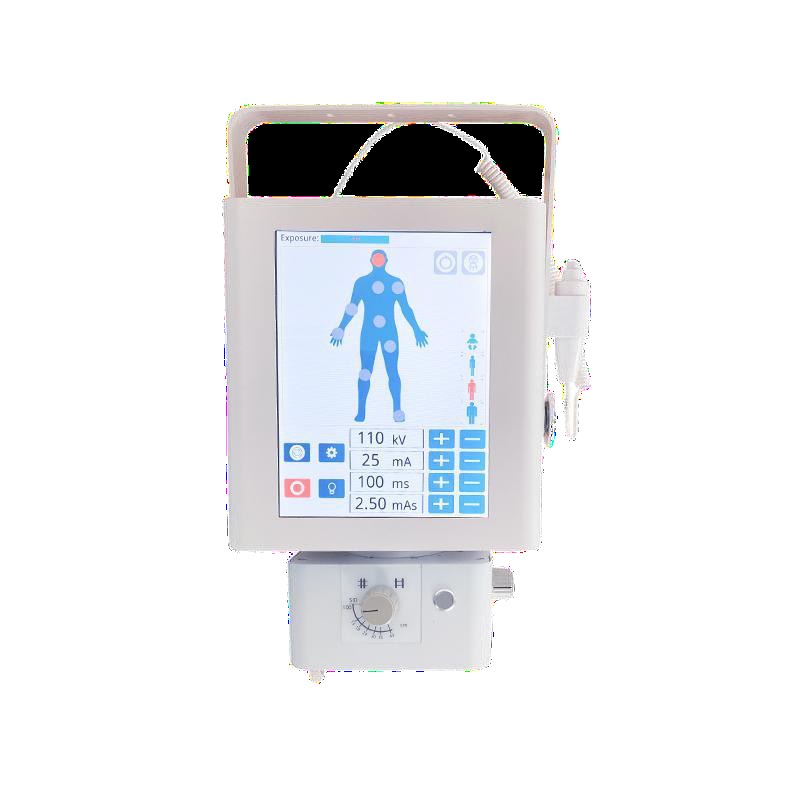
The third device is the one whose name misleads most. A portable radiographic X-ray unit — the kind hospitals, ambulances, field clinics, and veterinary services buy — is a genuine X-ray generator with outputs in a completely different class from the two devices above. Typical configurations in the 5–6 kW class offer tube potentials around 40–125 kV, tube currents from roughly 10–100 mA, and mAs ranges reaching into the hundreds, with system weights in the region of 15–18 kg before you add the detector.
Those numbers place it far beyond anything that should be in a hand during an exposure. “Portable” here means transportable between rooms, vehicles, and sites — carried by case, set on a stand or a table, and triggered from a hand-switch by an operator standing clear. Pairing the generator with a flat panel detector turns it into a complete portable DR system; the detector side of that pairing is a specialist topic we connect you to rather than duplicate here.
Who it is for: hospitals that need imaging at the bedside, clinics without a fixed radiography room, emergency and ambulance services, outreach programs, and veterinary practices working with animals that cannot come to a suite. A typical entry point is a 5 kW portable X-ray unit with anatomical presets and a carrying case; the full machine range extends from there into veterinary DR configurations and vehicle-mounted setups.
What it images: chest, limbs, spine, abdomen — the full range of planar radiography, on human and animal patients. If your use case involves any anatomy beyond the mouth, this — not a dental unit — is the device class you are shopping for.
The Three Devices Side by Side
| Handheld dental unit | Handheld fluoroscope | Portable radiographic unit | |
|---|---|---|---|
| Held during exposure? | Yes — by design, with shield and secured trigger | Positioned by hand, triggered hands-free where possible | No — placed and triggered from a distance |
| Output class | ~60–70 kVp, single short exposures | ~45–90 kV, continuous live imaging | 5–6 kW class, ~40–125 kV, mAs into the hundreds |
| Weight character | Lightest of the three | ~4–9 kg depending on screen and field | ~15–18 kg generator, case- or stand-transported |
| Image type | Still intraoral views | Live fluoroscopic image | Still radiographs of any anatomy |
| Typical buyer | Dental clinics, mobile dentistry | Orthopedics, surgery, veterinary procedures | Hospitals, field programs, veterinary practice, veterinary DR builds |
| Commonest buying mistake | Expecting it to image outside the mouth | Expecting still-image quality equal to radiography | Assuming it can be hand-held like the other two |
Which One Do You Actually Need? A Three-Question Test
- What anatomy are you imaging? Inside the mouth only → Type 1. Any larger anatomy, still images → Type 3. Live imaging during a procedure → Type 2.
- Do you need to see motion? Only fluoroscopy shows movement in real time. If your workflow is “position, expose, review,” a radiographic unit is the right tool and a fluoroscope is the expensive one.
- Where does the imaging happen? A dental chair bay favors Type 1; an operating table or exam table favors Type 2 or 3; a vehicle, a field site, or a stable pushes you firmly toward battery-powered equipment of Type 3, or toward whichever type matches the anatomy first.
What All Three Share: The Checks That Apply to Every Handheld-Class Purchase
Whatever type you land on, four checks are universal:
- Radiation protection fundamentals. Backscatter shielding where the device is hand-held, clear exposure indicators, secured triggering, and operator training on distance and time. Regulatory requirements differ by market, so confirm the approvals your country requires before import rather than after.
- Battery and power reality. Ask how many exposures the battery supports under your technique settings, how it charges, and what happens when it runs flat mid-list. For the larger portable class, confirm whether the unit also runs on mains power and which mains voltages it accepts.
- Compatibility with your receptor. A dental unit is only as good as its sensor; a portable generator is only a DR system once paired with a detector. Verify synchronization and image chain compatibility in writing before you order.
- Service and spares path. Portable equipment travels, and traveling equipment is dropped equipment. Ask what consumables and spare parts are available and how service is handled in your region.
Six Questions to Ask Before You Request a Quote
- Which of the three device types does this model actually belong to?
- What tube potential, current, and mAs ranges does it offer — and are they appropriate for my largest expected patient?
- What is included: cone, shield, case, stand, hand-switch, detector?
- How many exposures per battery charge at my typical technique, and what is the recharge behavior?
- Which regulatory approvals does the unit carry for my market, and what documentation comes with it?
- What warranty, spare-parts availability, and service response apply in my country?
Frequently Asked Questions
Is a handheld X-ray machine safe for the operator?
A compliant one is designed to be. Hand-held classes (dental and small fluoroscopes) carry backscatter shields, secured triggers, and exposure indicators precisely because the operator is close to the beam. Safety in practice still depends on training: keeping the cone or head positioned correctly, minimizing beam-on time, and following the protection rules your regulator sets. A portable radiographic unit removes the question almost entirely — you should never be holding it during an exposure.
Can a handheld dental X-ray machine take chest X-rays?
No. Its output and beam geometry are designed for intraoral imaging only. Chest and limb radiography belongs to the portable radiographic class. If a supplier suggests a dental unit for chest work, treat that as a disqualifying answer.
Is a portable X-ray machine the same as a mobile X-ray machine?
The words overlap, and usage varies by market. In practice, “portable” usually means a compact generator you can carry and set up in different locations, while “mobile” often refers to larger units on wheels for in-hospital bedside work. When comparing offers, look past the label at the power class, weight, and power source — the numbers tell you which one you are actually being shown.
Do handheld X-ray machines need a special license?
Almost everywhere, yes — all three types produce ionizing radiation and are regulated devices. Requirements range from device registration to operator licensing and room-protection rules depending on your country and the device class. Confirm with your national authority before shipment, and ask any supplier for the documentation your registration will need.
How long does the battery last on a handheld unit?
It depends on the device class, the exposure technique, and your workload, so ask suppliers to state expected exposures per charge under your settings rather than quoting a generic figure. For a full clinical day, also ask about swap-or-recharge behavior: whether the pack is replaceable and how long a recharge takes.
Can I use one device for both dental and small-animal work?
Sometimes — but the receptor and technique ranges decide, not the name on the box. Some dental-class handhelds are used for small-animal intraoral work, and portable radiographic units paired with a detector serve small-animal radiography well. State both use cases to your supplier explicitly and ask for a configuration that covers them.
Not sure which of the three you need? Tell us what you image, where, and how often — we will point you to the right device class and a configuration that fits, before you spend a cent.
Email: admin@newheek.cn | Phone / WhatsApp: +86 19062611512