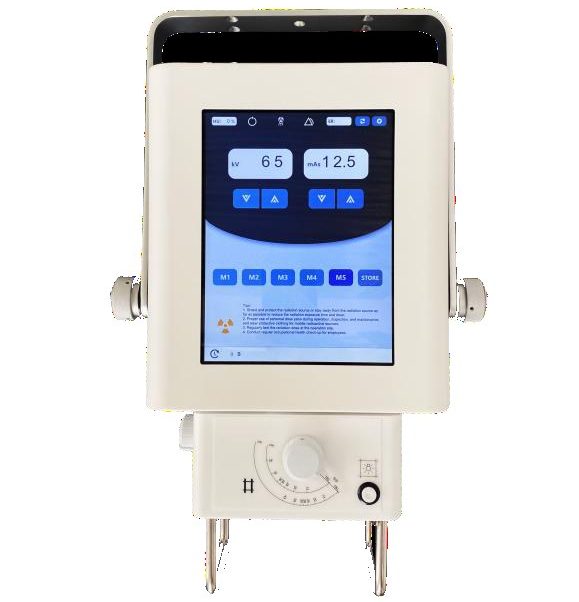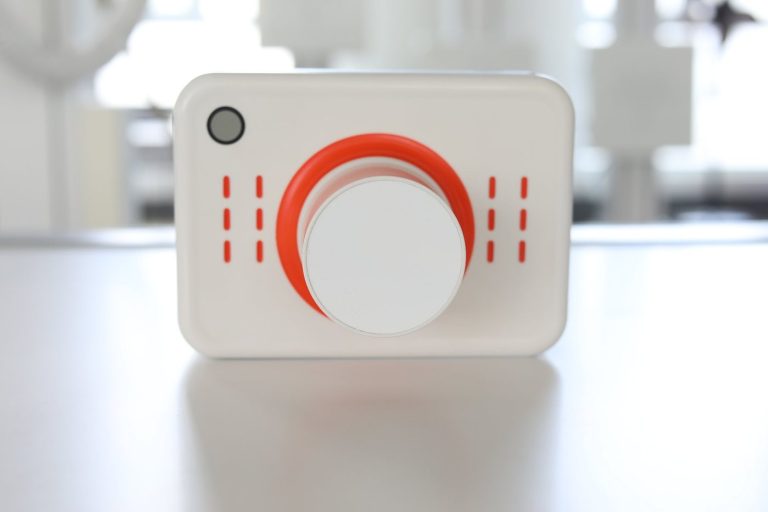
Quick answer: a portable fluoroscopy system shows you a moving image while you work. A C-arm shows the same kind of moving image, but it is built to swing around a patient lying on an operating table. A handheld X-ray unit takes one still picture, from a case you can carry in one hand. Three machines, three different jobs — and the words salespeople use for them overlap far more than the jobs do.
Not long ago a customer called me with what sounded like a simple request. He wanted to buy “a portable fluoroscopy machine.” He had asked three suppliers and received three different answers: one sent him a handheld unit in a carry case, one sent a C-arm quotation, one sent a small unit that hooks up to a monitor.
He was confused, and he had reason to be. What he actually wanted, he said at the end of the call, was to see whether the pin he had just driven in had landed where he planned. That single sentence answers the whole question. He needed a moving image, small field, next to the patient, and he did not need anything that swings around an operating table.
This article sorts the three devices by what they do in the room, not by what they are called on a spec sheet. Orthopedics, emergency, ICU and veterinary work each pull the decision in a different direction.
1. Three devices, and why the names blur together
The confusion starts with two words. “Portable” is an adjective in this industry, not a category — almost everything gets called portable once it has a handle or a wheel. “Fluoroscopy” describes a capability, not a shape: it means you are looking at a moving image while the beam is on. Put the two words together and you can describe at least three different machines, which is exactly what happens in every second enquiry. (We went through the naming problem separately in what a handheld X-ray machine actually is; this article is about which one fits which room.)
The handheld unit
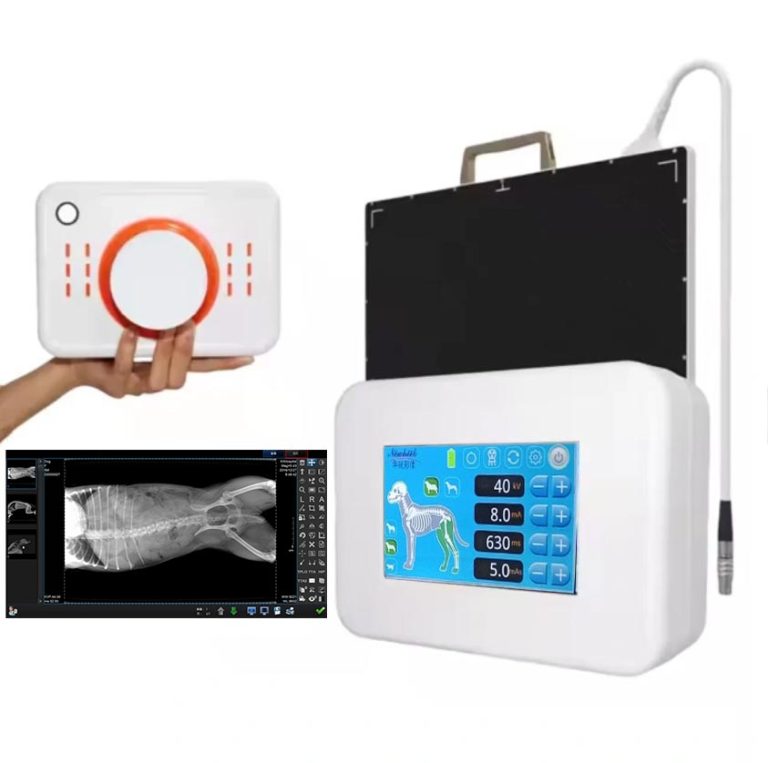
A handheld X-ray unit is a tube, a battery and a trigger in one housing, usually a few kilograms, often with a backscatter shield around the cone. You point it, you fire, you get one frame. It is the closest thing in radiography to a torch: small, quick, and good at answering a single closed question — is there a foreign body, is the bone aligned, did the pin pass through both cortices.
It does not give you a moving picture. That is not a limitation anybody forgot to fix; it is what makes the device small enough to carry. If you want to watch a fracture move while you pull on it, a handheld unit will not do it. The units we list under X-ray machines sit in this family, alongside the portable generators they pair with.
The portable fluoroscopy system
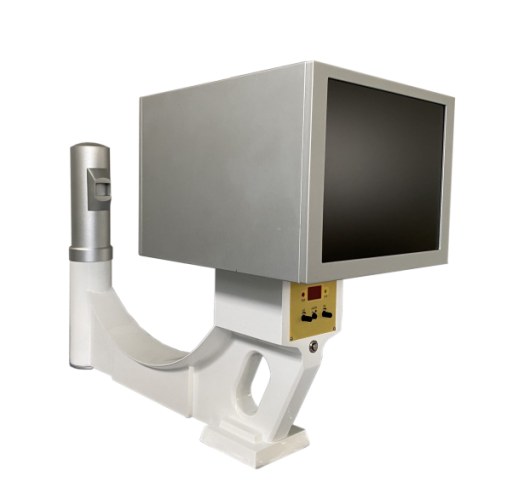
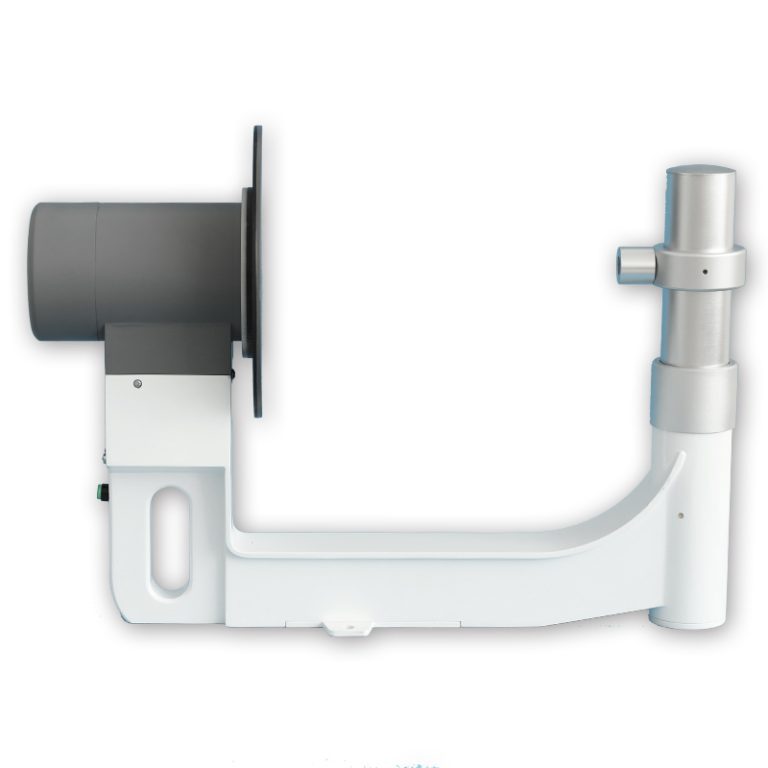
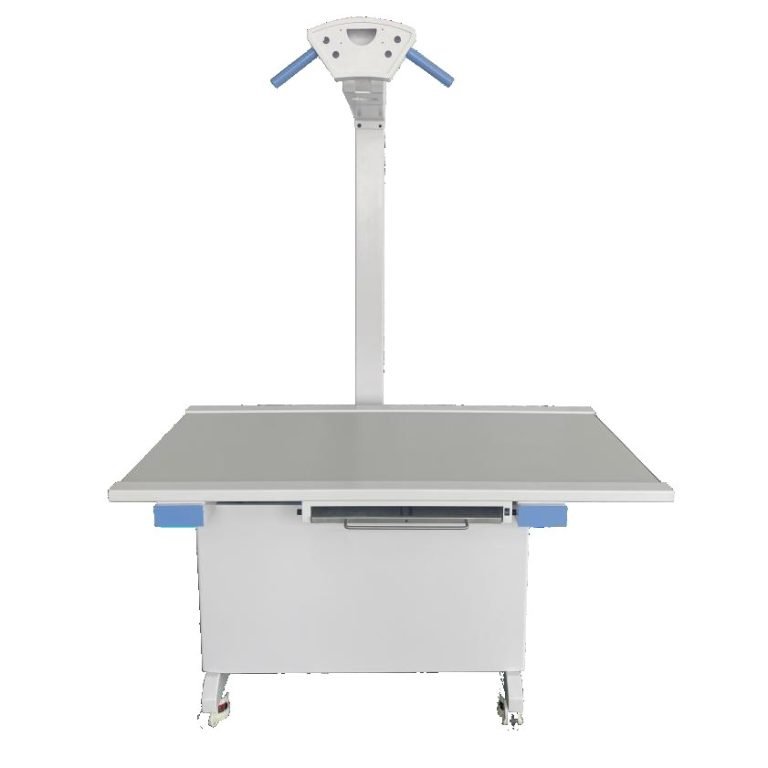
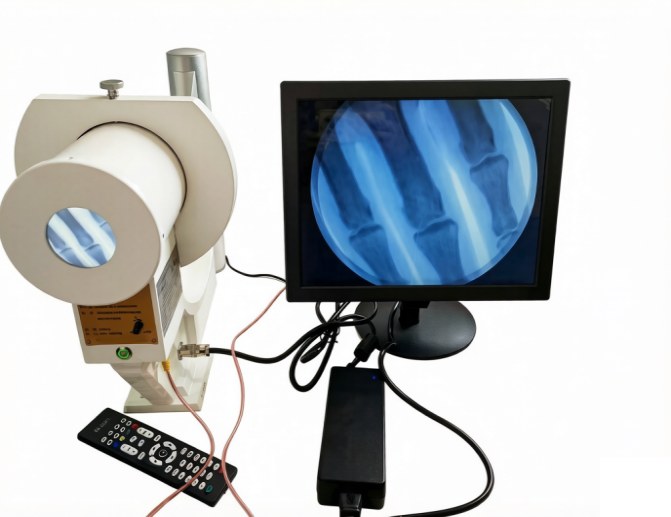
This is a small fluoroscopy unit — tube and detector held in a compact frame or on a short stand, with the image going to a screen you place wherever it is convenient. It shows a moving image, which puts it in the same working category as a C-arm, at a fraction of the footprint and the cost.
What it gives up is reach. The field of view is small by design, the frame does not rotate around the patient, and there is no way to drape it into a sterile field the way a proper C-arm gets draped. Within those limits it is genuinely useful, and the limits are predictable enough to plan around. The compact units we currently offer are grouped under portable fluoroscopy systems, and the field-of-view difference between them is the first thing worth checking against your case list.
The C-arm
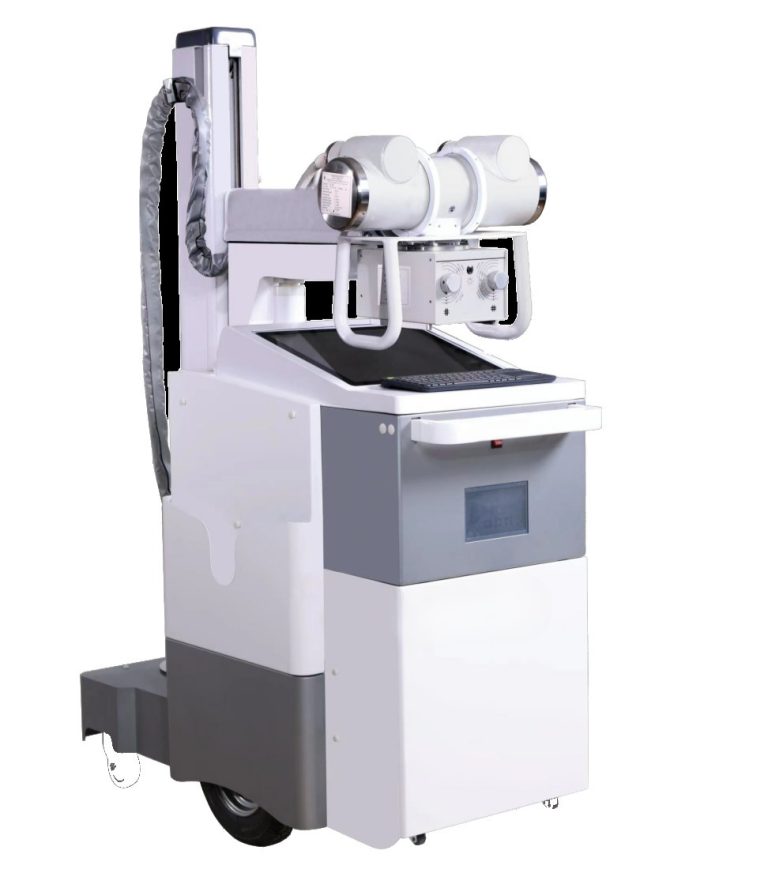
A C-arm is the operating-room answer: a C-shaped gantry that carries the tube on one end and the detector on the other, so the imaging chain can be rotated around the patient without moving the patient. Large field, steep angles, built-in shielding, designed to be covered and used inside a sterile field.
Everything that makes it good in an OR makes it awkward everywhere else. It is heavy, it wants mains power, it needs a room with the door and the floor space to take it, and it costs accordingly. Nobody wheels a C-arm into a consulting room to check a cat’s tibia.
2. The only question that really sorts them: still or moving?
Forget categories for a moment and ask what happens during the examination.
If the answer is “I take a picture, then I look at it and decide,” you are buying a still-image device, and the handheld unit or a portable DR is the right family.
If the answer is “I need to see the anatomy move while I do something to it,” you need fluoroscopy. Then the second question is whether the anatomy has to be approached from more than one angle without repositioning the patient. If yes, that is a C-arm. If the work is small, peripheral, and can be done with one fixed viewing direction, a portable fluoroscopy unit covers it.
Two questions, and most of the shortlist is decided before anybody talks about brands.
3. Orthopedics: where the line actually falls
Orthopedics is where buyers most often over-buy or under-buy, because the specialty covers everything from a distal radius to a whole femur.
Comfortably inside a portable fluoroscopy unit’s range: closed reduction of wrist, forearm, ankle and small bone fractures; checking screw and K-wire position; removing hardware; foreign body localisation in a hand or foot. These are small fields, the hand does the work, and the value of the moving image shows up immediately — you reduce, you look, you adjust, without walking to a darkroom and without re-positioning the patient.
Where a C-arm earns its price: long-segment work such as femur, pelvis and spine; intramedullary nailing where you need to see the whole length; anything requiring oblique views that would mean moving the patient on the table; arthroplasty and procedures where the imaging chain has to be draped into the sterile field.
A blunt way to decide: look at your last fifty cases. If most of them are wrist, ankle and hand, a C-arm spends most of its life doing a job a small fluoroscopy unit could have done, and you have paid for reach you never use. If you are running long-bone trauma every week, a small unit will leave you stuck mid-case, and no amount of technique fixes a field of view that does not cover the anatomy.
4. Emergency: three rooms, three different answers
In an emergency department the three devices rarely compete, because they end up in different rooms.
Resus and minor procedures. Glass in a foot, metal in a hand, a suspected foreign body in a wound — this is handheld or small fluoroscopy territory, and the deciding factor is that nobody wants to move the patient to the imaging room. A portable fluoroscopy unit earns its place here when the question is “is it still in there” and the answer changes as you pull.
The emergency theatre. C-arm, for the reasons in the previous section.
Triage, pre-hospital, disaster response, outreach. A handheld unit, a detector and a laptop, running on battery, in two cases. Nothing else in this comparison travels like that.
One practical note that gets missed in the brochure: a C-arm is designed so that the operator stands behind built-in shielding. With handheld and small portable units, protection is a matter of distance, a lead apron and technique. That is manageable — it is how these devices are used every day — but it is a workflow decision, not a footnote, and it should be priced into staff time and training.
5. ICU and the bedside: what can physically get to the patient
A C-arm does not go into an ICU bed space. Not because of the image quality, but because of the door width, the floor space, the power drop and the fact that a critically ill patient cannot be moved to accommodate a machine.
This is the clearest case where the decision is made by logistics rather than by imaging performance. A portable fluoroscopy unit can be brought to the bed space on its stand, and a handheld unit can be brought to the patient in a carry case. Both let the examination happen where the patient already is.
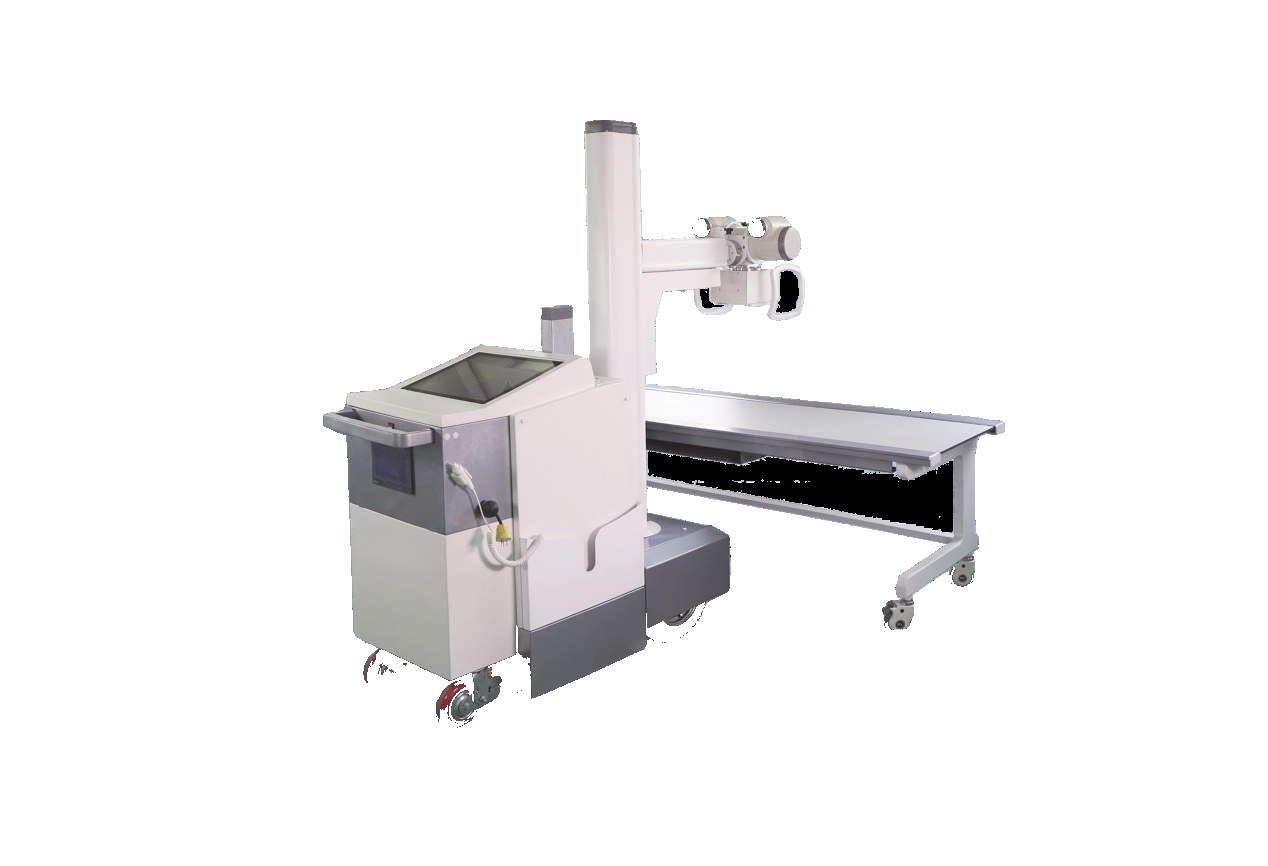
What each is good for at the bedside depends on the clinical question and on your local protocol — line and tube position checks, diaphragm movement, quick positional confirmation during a procedure. The honest framing is this: the bedside is where “can the machine get here” beats “how good is the image at maximum settings,” because a machine that stays in the corridor produces no image at all.
For plain bedside chest work the answer is usually neither of the fluoroscopy options: a handheld unit or a portable DR takes the still image faster and with less setup.
6. Veterinary: where handheld and portable fluoroscopy win outright
Animal work changes the calculation in two ways. First, the patient cannot be instructed to hold still or hold a breath, so anything that shortens the time between “position” and “image” is worth more than it is in human medicine. Second, a large share of the work happens outside a hospital — a stable, a farm, a field trial, a client’s home.
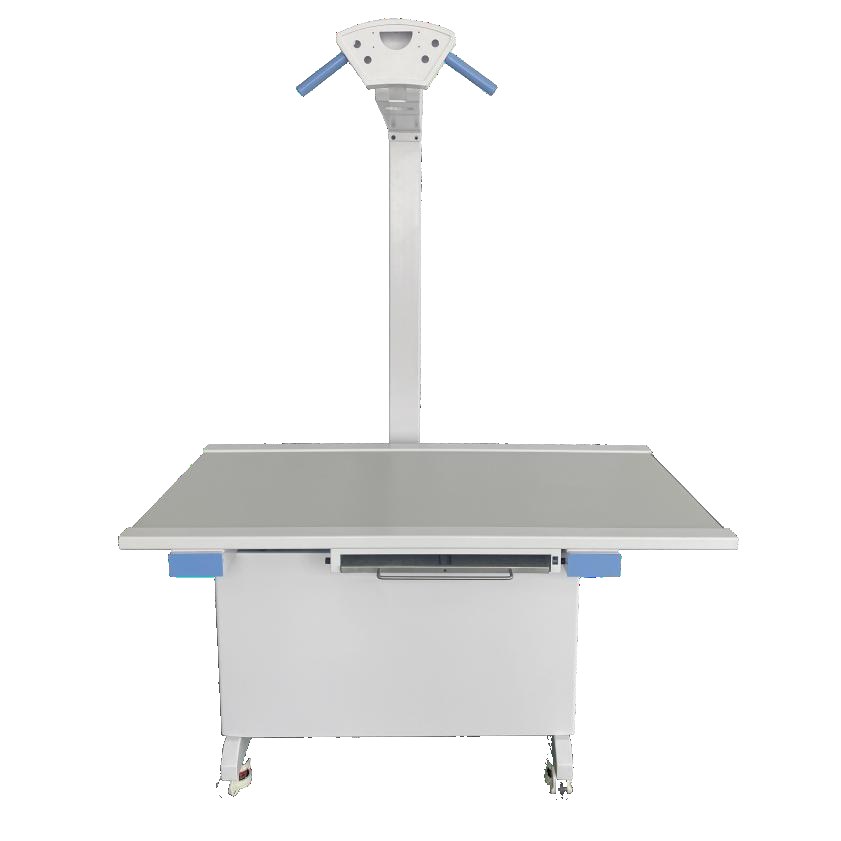
Small animal practice. A handheld unit covers limbs, digits, dental work and foreign body checks, and it goes into the consult room. A portable fluoroscopy unit covers the intraoperative questions — is the fracture reduced, is the plate sitting on the bone, has the pin engaged — with a moving image and a field that fits a small patient comfortably.
Equine and large animal. This is handheld territory, and the requirements are physical rather than optical: a case that survives being loaded into a vehicle, battery life that covers a day away from mains power, and a device that one person can set up alone. Field radiography lives or dies on whether the kit is still working at the fourth stop of the day.
Referral and specialty hospitals. This is where a C-arm starts to make sense in veterinary practice, for the same long-bone and spinal work as in human orthopedics.
A pattern worth noticing: in veterinary work, the “moving image” advantage is often worth more than the “bigger field” advantage, because the animal will not hold the position you asked for. That pushes small-animal buyers toward portable fluoroscopy and away from a C-arm they would struggle to justify.
7. Side by side
| What you are comparing | Handheld X-ray | Portable fluoroscopy | C-arm |
|---|---|---|---|
| Type of image | Still frame, one exposure at a time | Moving image while the beam is on | Moving image while the beam is on |
| Typical field of view | Small to medium, aimed by hand | Small to medium, fixed frame | Large, and rotatable around the patient |
| Getting to the patient | Carried in a case | Wheeled or carried to the bed space | Confined to rooms that can take it |
| Power | Battery | Mains or battery, depending on model | Mains |
| Working around the table | No | Limited to one viewing direction | Yes, this is what it is built for |
| How protection is handled | Shield at the source, plus distance and apron | Distance, apron, technique, collimation | Built-in shielding for the operator |
| Where it fits | Point-of-care stills, field work, triage | Clinic and bedside fluoroscopy, small-bone orthopedics, veterinary | Operative and interventional work |
| Most common buying mistake | Bought to replace a C-arm | Bought for anatomy its field cannot cover | Bought for a clinic that will never use the reach |
8. Five questions to settle before you sign anything
- What exactly do you need to watch move? If you cannot name the procedure, you probably need stills, and the fluoroscopy budget is being spent on a feeling rather than a task.
- What is the largest anatomy you must see in one view, with margin? Field of view decides whether a device is usable for a given case. Resolution does not rescue a field that stops halfway down the femur.
- Where will it physically go? Measure the door, the lift and the bed space before you compare specifications. A machine that does not fit through the door has no specifications.
- Who holds the detector, and what is their protection plan? In handheld and small portable work, the person positioning the patient is often the person closest to the beam. Decide how that is handled before the device arrives, not after.
- Who comes when it breaks, and how fast? Consumables and service response matter more on a device that earns its keep in the middle of a procedure than on one that sits in a room.
Frequently asked questions
Can a portable fluoroscopy unit replace a C-arm?
For small-field, single-direction work — distal limb fracture reduction, hardware checks, foreign bodies — yes, in practice it often does. For long-segment anatomy, oblique views without repositioning the patient, or imaging inside a sterile field, no. The field of view and the fixed frame are the two limits that cannot be worked around.
Is a handheld X-ray the same as a handheld fluoroscopy unit?
No. Both are small enough to carry, which is where the confusion comes from, but one takes a still frame and the other shows a moving image. If a supplier uses the two terms interchangeably, ask for a demonstration of the live view before you order.
Which one suits a small animal clinic?
Usually a handheld unit for everyday stills plus, if you do orthopedic surgery, a portable fluoroscopy unit for intraoperative checks. A C-arm is hard to justify unless the practice is doing referral-level long-bone and spinal work.
Can fluoroscopy be done in an ICU?
The portable form can be brought to the bed space, which is the main reason it gets used there. Whether a specific examination is appropriate at the bedside is a clinical and protocol question, and the protection plan for staff still has to be in place.
Do I need a dedicated room?
Not for a handheld unit or a portable fluoroscopy system, which is the point of both. A C-arm effectively needs a room it can be moved around in, which is a capital-planning question as much as a clinical one.
If you are still not sure which one you are shopping for
Send us the procedure list — the operations you actually do in a normal month — and we will tell you which of the three families covers it, including the cases where the honest answer is that you need a C-arm and we do not sell one. That conversation usually takes less time than reading another specification sheet.
Talk to us about your case mix: Email admin@newheek.cn, phone or WhatsApp +86 19062611512, or leave a message on our contact page. Tell us what you need to see, and how big it is — that is enough to start.